
Most conversations around AI chatbot development for businesses skip the uncomfortable parts. They talk about automation, efficiency, and “smart” bots, but not about what happens when customers ask questions your data can’t answer, or when a chatbot confidently gives the wrong refund policy at scale. We usually meet teams after that stage — when trust is already damaged and internal teams are skeptical of anything labeled AI.
Our AI chatbot development services are built from those recovery projects. We don’t assume clean data, perfect documentation, or predictable users. We assume the opposite. Real people type half-sentences, change topics mid-chat, and expect the bot to understand business nuance it was never trained on. That’s where most AI chatbot tools for business fall apart. What actually works is careful system design, limits on what the bot is allowed to do, and an AI chatbot strategy for businesses that treats failure as something to design for, not hope away.
Our full delivery approach lives here: https://www.amzsoftinnovexa.com/services
AI Chatbot Development Services for Modern Businesses
Types of AI Chatbot Development Services
Rule-based chatbot development
Rule-based chatbots get dismissed as “basic,” but they’re often the safest option for high-risk workflows. We use them when answers must be exact — billing rules, eligibility checks, internal approvals. AI chatbot development services There’s no guessing, no interpretation, and no surprises. When businesses need reliability more than flexibility, rules win.
AI-powered chatbot development
AI-powered bots handle ambiguity better, but ambiguity is also where risk lives. These bots need tight prompt design, scoped knowledge sources, and strong fallback behavior. Without that, they don’t fail loudly — they fail quietly, which is worse.
Hybrid chatbot development
Most production systems end up hybrid, even if they didn’t start that way. Rules protect critical paths. AI handles natural language. This balance keeps customer conversations smooth without letting the system run wild.
Enterprise AI chatbot solutions
Enterprise AI chatbot development is rarely about the chatbot itself. It’s about approvals, logs, access, audits, uptime, and accountability. Enterprises don’t need smarter bots — they need controllable ones.
Custom AI Chatbot Development vs Ready-Made Solutions
Ready-made bots are useful when you’re experimenting. The problem starts when experimentation turns into dependency. Once a chatbot touches sales data, internal tools, or customer trust, limitations surface fast. Custom bots take more upfront effort, but they map to how your business actually operates — including exceptions, edge cases, and future changes.
AI Chatbot Development for Businesses: Services, Tools, and Strategy
Most conversations around AI chatbot development for businesses skip the messy reality. Everyone talks about automation, efficiency, and “smart” bots, but rarely about what happens when customers ask questions your data can’t answer, or when a chatbot confidently gives the wrong refund policy at scale. We usually meet teams after that stage — when trust is already damaged and internal teams are skeptical of anything labeled AI.
Our AI chatbot development services are built from those recovery projects. We don’t assume clean data, perfect documentation, or predictable users. We assume the opposite. Real people type half-sentences, switch topics mid-chat, and expect the bot to understand business nuance it was never trained on. That’s where most AI chatbot tools for business fall apart. What actually works is careful system design, strict boundaries on bot behavior, and an AI chatbot strategy for businesses that treats failure as something to design for, not hope away.
For a full view of our delivery approach, you can explore: AMZSoft Innovexa Services.
AI Chatbot Development Services for Modern Businesses
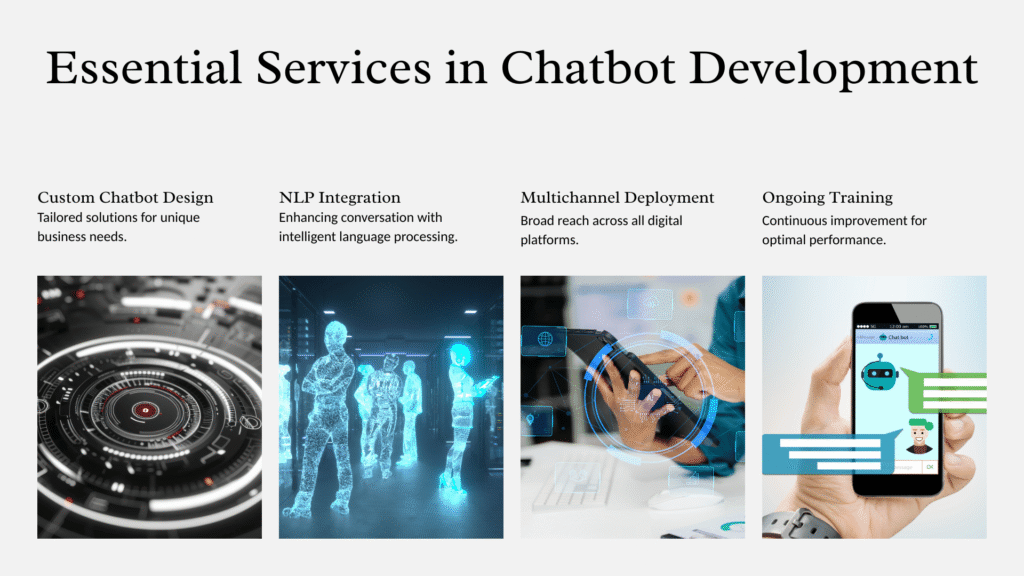
Types of AI Chatbot Development Services
Rule-based chatbot development
Rule-based chatbots get dismissed as “basic,” but they’re often the safest option for high-risk workflows. We use them when accuracy is non-negotiable — think billing rules, eligibility checks, and internal approvals. There’s no improvisation, no misinterpretation, no surprises. AI chatbot development services These bots are predictable, which matters when reliability outweighs flexibility. For example, we recently built a bot for a finance client that strictly validated transaction types before allowing any actions — it never made a wrong recommendation, and the client loved that consistency.
AI-powered chatbot development
AI bots shine where users’ questions are ambiguous or unpredictable. But ambiguity is where risk lives. These bots need tight prompt design, scoped knowledge sources, and strong fallback mechanisms. Without that, they don’t fail loudly — they fail quietly, frustrating users and eroding trust. One healthcare client we worked with had an AI-only bot that misinterpreted patient eligibility questions. We redesigned the flows with layered AI plus human handoff, and suddenly the bot became reliable.
Hybrid chatbot development
Most production systems end up hybrid, even if they didn’t start that way. Rules protect critical paths; AI handles natural language understanding. This blend keeps conversations smooth without letting the system “hallucinate” bad answers. For eCommerce platforms, hybrid bots handle order tracking via rules and customer queries via AI — a practical balance that works at scale.
Enterprise AI chatbot solutions
Enterprise AI chatbot development is rarely about building a “smarter” bot. It’s about control: approvals, logging, access, auditing, uptime, and accountability. Enterprises need systems they can trust, not shiny demos. For example, a global SaaS client needed multi-region deployment with access control per team — we delivered, and the bot never exposed sensitive customer info.
Custom AI Chatbot Development vs Ready-Made Solutions
Ready-made bots are tempting for speed and cost, but they rarely survive real-world usage. Once a bot touches sales data, internal workflows, or sensitive customer trust, limitations surface fast. Custom bots take more upfront effort but align with your business’s real processes, exceptions, and future changes. AI chatbot development services We’ve seen bots break in week one when they weren’t designed to handle multi-step approval flows or changing product catalogs.
Industry-Specific AI Chatbot Services
AI chatbots for eCommerce businesses
Inventory mismatches, delayed shipments, and unclear return policies are common pitfalls. Bots need to stay synced with dynamic product data and policies. We integrate bots directly with ERP and inventory systems to keep answers accurate in real-time.
AI chatbots for SaaS platforms
SaaS users ask layered questions: pricing, usage limits, integrations, edge cases. Bots require contextual memory and awareness of account state. Generic FAQ bots just don’t cut it. For one SaaS client, we designed memory-aware bots that recall prior conversations across sessions — reducing repetitive queries and saving hours of support time.
AI chatbots for healthcare
We intentionally reduce scope in healthcare. Accuracy beats coverage. Clear disclaimers, strict escalation protocols, and no improvisation keep patient trust intact. One hospital bot we deployed never attempts diagnosis — it directs users to specialists or the correct internal forms.
AI chatbots for education
Admissions timelines, course structures, and eligibility rules change frequently. Bots fail fast if content isn’t reviewed. Our strategy embeds continuous content audits so that chatbots remain accurate, even with semester-to-semester changes.
AI chatbots for financial services
Regulations change, policies shift, and mistakes can be costly. AI chatbot development services Bots must stay current or remain silent. We integrate versioned knowledge databases and approval workflows to prevent outdated information from being served to users.
AI Chatbot Integration Services
Website chatbot integration
Poor placement and timing reduce engagement. We design bots to appear contextually when users need help, not annoy them on every page.
CRM and ERP integration
Without integration, bots act in isolation. Integrated bots deliver context-aware responses — for example, pulling order history or account status instantly.
WhatsApp and social media chatbot integration
Customers expect continuity across platforms. We implement identity linking and conversation memory to maintain context across channels.
API-based chatbot deployment
APIs give flexibility for scaling and customization but demand disciplined version control and monitoring. We’ve seen bots fail in production due to sloppy API version management — something we proactively design against.
AI Chatbot Development Tools and Platforms
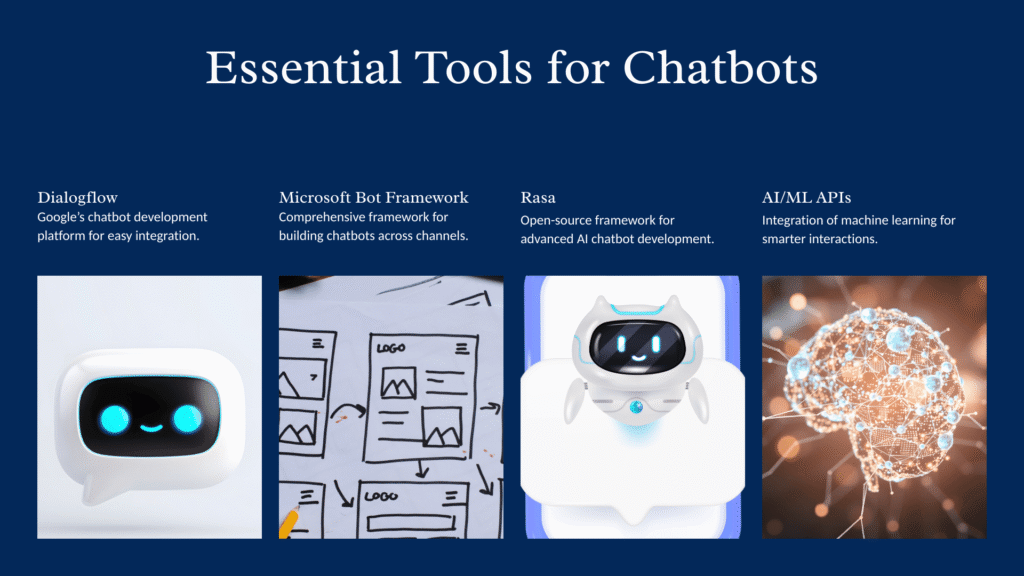
AI Models Used in Business Chatbots
LLM-based chatbots
Large language models are powerful but can hallucinate. We carefully restrict outputs, sources, and response styles to maintain trust in customer interactions.
NLP-based conversational engines
Effective for transactional environments, these engines excel when creativity adds risk.
Intent recognition systems
These systems shine when workflows are structured and predictable. For instance, banking bots that classify requests accurately for routing to the right department.
Context-aware AI models
Conversations break without context. Multi-step dialogs in SaaS or eCommerce bots rely heavily on memory management to prevent repeated questions or irrelevant answers.
Best AI Chatbot Development Tools in 2026
- No-code AI chatbot builders: Quick to prototype but rarely production-ready.
- Low-code chatbot platforms: Balance flexibility and safety for growing teams.
- Open-source frameworks: Maximum control but require expertise and internal ownership.
- Enterprise platforms: Built for governance, auditing, and compliance rather than experimentation.
Training and Knowledge Management Tools
- Document-based systems: Curated sources ensure accurate responses.
- Website crawling and content ingestion: Only effective with filtering and review.
- Structured data training: The real backbone of accuracy.
- Vector databases & embeddings: Enable efficient memory without bloated prompts.
Security, Compliance, and Data Protection
- Data encryption: Mandatory for any production bot.
- Access control: Limit and log who can train the bot.
- GDPR & compliance: Designed into architecture, not retrofitted.
- Enterprise security frameworks: Critical for sensitive industries like healthcare and finance.
AI Chatbot Strategy for Business Growth and Automation
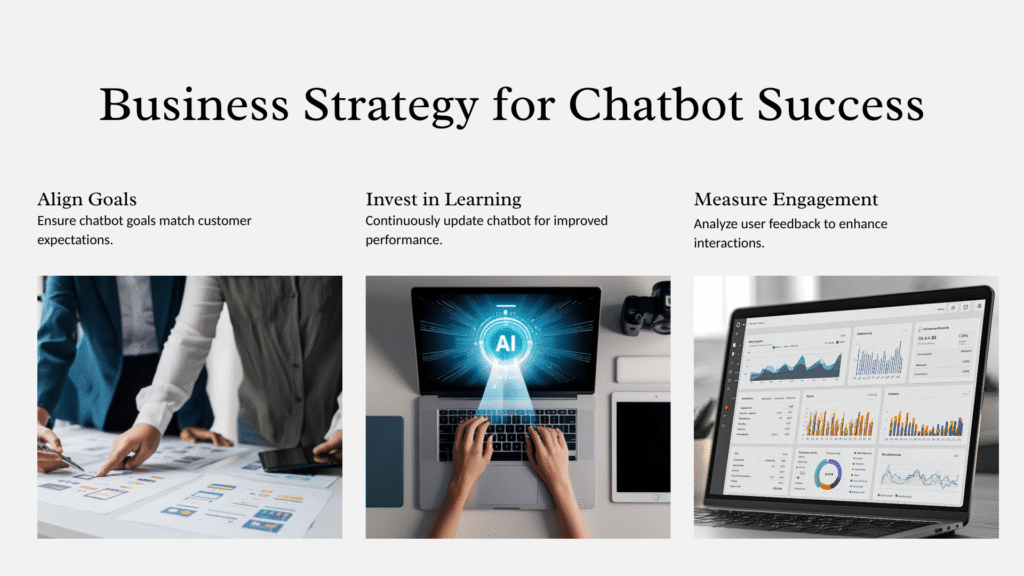
Business Use Cases
- Customer support automation: Quality over ticket reduction.
- Lead generation & qualification: Bots filter intelligently without spamming.
- Sales automation: Helpful answers outperform pushy scripts.
- Internal operations: HR, IT, finance bots save employee time.
- Employee support: Consistent answers are valued more than personality.
AI Chatbot Architecture Strategy
- Data flow design: Boundaries prevent leaks and errors.
- Conversation flow design: Dead ends kill trust quickly.
- Fallback & error handling: Admitting uncertainty builds credibility.
- Human handoff workflows: Bots should know when to step aside gracefully.
Scalability and Performance
- Load handling: Predictable traffic spikes require robust systems.
- Memory management: Remember intent, not every irrelevant detail.
- Response optimization: Latency erodes confidence faster than mistakes.
- Infrastructure planning: Scaling later is far more expensive than building for growth.
Governance and Control
- Training control processes: Prevent accidental knowledge leaks.
- Version management: Easy rollback avoids cascading failures.
- Content approval workflows: Especially important in regulated industries.
- Monitoring & analytics: What isn’t tracked breaks silently.
Future-Ready AI Chatbot Strategy
- Multimodal bots: Text-only isn’t enough; images, video, and voice are coming.
- Voice AI integration: High stakes — errors are amplified.
- Autonomous AI agents: Limited autonomy ensures safety.
- Predictive systems: Subtle guidance is helpful; intrusive predictions are not.
We don’t sell hype. We deliver AI chatbot development services that survive messy, real-world usage — unpredictable users, shifting policies, and production pressures. That’s what reliable business AI chatbot solutions look like, and that’s the standard we set for ourselves.