
Most businesses start looking into AI Chatbots for Support after a familiar problem shows up—support tickets keep increasing but the team size stays the same. We’ve worked with companies where agents spend half their day replying to the same shipping questions or login issues. That’s where an AI customer support chatbot starts making practical sense. Instead of replacing people, it handles the repetitive layer of conversations that slows everyone down. Good chatbot automation for customer service quietly takes care of order status checks, refund policies, appointment confirmations, and those late-night messages that otherwise wait until morning. Over time the inbox looks very different. Businesses also begin to notice fewer missed leads coming through support chat. The real shift happens when teams stop firefighting small queries and focus on complex issues that actually need human judgment. That’s why many companies are now revisiting AI Chatbots for Support, even if they had a bad experience with bots years ago. The modern systems are built around real workflows, not just scripted responses. And once they’re set up properly, the benefits of AI chatbots in customer support become visible pretty quickly.
How an AI Customer Support Chatbot Works
An AI customer support chatbot usually works behind the scenes in a way that feels simple to the user but requires careful setup. When someone types a message—maybe asking where their order is—the system quickly interprets the intent of that question. From there, it checks a knowledge base, support database, or order system to find the most relevant answer. Good AI Chatbots for Support don’t just spit out canned responses; they follow conversation flows based on what the user actually needs. If the issue is simple, the chatbot resolves it instantly. If it’s more complex, it passes the conversation to a human agent with the context already attached. This combination is what makes chatbot automation for customer service practical rather than frustrating. In many implementations we build, the bot handles the first layer of conversation while the support team handles exceptions. Over time the chatbot learns which questions appear repeatedly and improves its responses. Businesses then start seeing measurable benefits of AI chatbots in customer support, especially in reduced ticket load. It’s less about artificial intelligence sounding impressive and more about systems quietly solving everyday support problems.
Natural Language Processing (NLP) and Machine Learning Basics
When people hear about AI Chatbots for Support, they often imagine complex technology running in the background. The truth is a bit more practical. Most modern chatbots rely on Natural Language Processing to understand what customers are trying to say, even when the wording isn’t perfect. Someone might type “where is my package” or “track order pls,” and the AI customer support chatbot still understands the intent. Machine learning then helps the system improve over time as it processes more real conversations. In the early days of chatbots, everything had to be manually scripted, which made them rigid and frustrating. Now the system adapts based on patterns in customer questions. That flexibility is what makes chatbot automation for customer service actually usable for busy support teams. We often train these systems using past support tickets so the bot learns from real situations. Over time it becomes surprisingly good at identifying common issues before they escalate. The benefits of AI chatbots in customer support start appearing when the bot consistently resolves those routine requests. It’s not magic—it’s simply software getting better with experience.
Automating Customer Queries with Chatbot Automation for Customer Service
A big part of implementing AI Chatbots for Support is deciding which conversations should be automated first. We usually start by looking at support inbox data, because the patterns are almost always obvious. Questions about shipping times, account access, refunds, or product availability show up repeatedly. These are perfect candidates for chatbot automation for customer service because they follow predictable paths. An AI customer support chatbot can instantly guide customers to the right answer instead of making them wait hours for a reply. It can also collect details before handing the conversation to an agent, which saves time for everyone involved. Over weeks, this small shift dramatically reduces repetitive workload. Support teams begin noticing they are dealing with fewer basic queries and more meaningful conversations. That’s where the benefits of AI chatbots in customer support really show up—less burnout, quicker responses, and better organization of incoming requests. Businesses often discover that many tickets never needed a human response in the first place. Once automation handles those, the entire support system feels lighter.
Benefits of AI Chatbots in Customer Support
The benefits of AI chatbots in customer support become obvious once a business has dealt with growing support demand for a while. Without automation, teams often spend hours answering the same handful of questions every day. That repetition drains time and delays responses for customers who actually need help. AI Chatbots for Support step into that gap and handle the predictable conversations automatically. An AI customer support chatbot can answer instantly, even when the team is offline or overloaded. This is where chatbot automation for customer service quietly improves both speed and consistency. Customers get immediate replies instead of waiting in queues. Support teams gain breathing room to investigate complicated problems instead of racing through small ones. Businesses also start noticing fewer abandoned chats and fewer missed opportunities. In many cases, support channels even begin capturing leads instead of losing them. The technology works best when it supports the human team rather than trying to replace it. That balance is exactly where the real value appears.
24/7 Customer Assistance Without Human Limitations
One of the most practical reasons businesses implement AI Chatbots for Support is the ability to respond at any hour. Customers don’t always reach out during office time; they ask questions late at night, early in the morning, or during weekends. Without automation, those messages sit unanswered until the next shift begins. An AI customer support chatbot fills that gap by responding instantly, even outside working hours. It might help someone track an order, reset an account password, or find a product page within seconds. This is where chatbot automation for customer service becomes extremely useful. Instead of building overnight support teams, businesses allow the chatbot to handle routine requests. The next morning the human team sees fewer unresolved tickets waiting in the queue. Over time, the benefits of AI chatbots in customer support become noticeable in faster resolution times. Customers appreciate getting answers right away rather than waiting for business hours. And the support team starts their day with a manageable workload instead of an overwhelming backlog.
Reduced Support Costs and Faster Response Time
Support costs often grow quietly as a company scales. More customers mean more messages, and eventually more support agents are required. AI Chatbots for Support help slow that growth by absorbing the repetitive workload that normally requires additional staff. An AI customer support chatbot can handle hundreds of conversations at the same time without slowing down. That alone dramatically improves response speed. Instead of waiting several hours for a reply, customers often receive answers within seconds. This kind of chatbot automation for customer service also keeps the support queue organized by filtering simple issues from complex ones. Agents spend less time copying answers from templates and more time solving real problems. The benefits of AI chatbots in customer support aren’t just about saving money—they’re about running a smoother operation. Businesses maintain quality support even as customer numbers grow. That balance between efficiency and service quality is exactly why many teams adopt chatbot systems.
Improved Customer Experience and Satisfaction
Customer satisfaction often drops when responses take too long or answers feel generic. We’ve seen situations where customers simply leave because no one replied quickly enough. AI Chatbots for Support reduce that risk by responding immediately and guiding users toward helpful information. A well-trained AI customer support chatbot can understand what someone is asking and direct them to the right solution. Sometimes that means sharing a help article; other times it means connecting them to a human agent with the conversation context already attached. This kind of chatbot automation for customer service keeps interactions smooth instead of frustrating. Customers don’t need to repeat their issue multiple times. Over time, the benefits of AI chatbots in customer support show up in higher satisfaction scores and better feedback. People appreciate fast answers even for simple questions. When the system works well, most customers don’t even realize automation handled the first part of the conversation. They just know the problem got solved quickly.
Top Use Cases of AI Chatbots for Customer Support
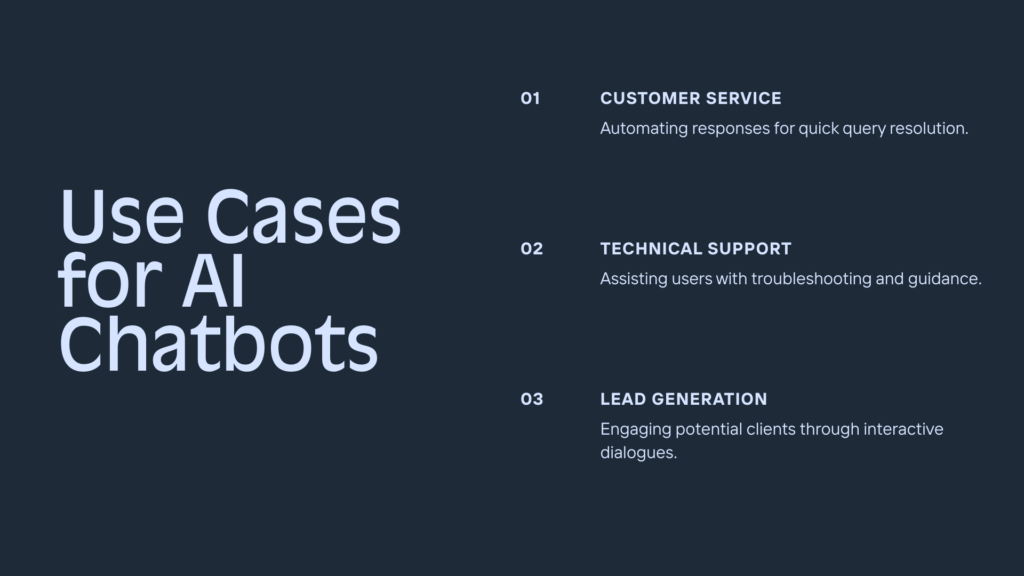
Businesses exploring AI Chatbots for Support usually want to know where the technology actually helps the most. From our experience, the best use cases appear where support teams deal with predictable questions every day. That might be order tracking, account setup, subscription questions, or product information. An AI customer support chatbot can handle those interactions immediately without involving an agent. This is exactly where chatbot automation for customer service removes friction from the support process. Instead of customers waiting in long queues, they get direct answers or clear instructions. Businesses also start capturing information that used to disappear in chat conversations. That includes potential leads, product interest, and early support signals. Over time the benefits of AI chatbots in customer support expand beyond support alone. Marketing and sales teams often find value in the insights generated from chatbot interactions. What begins as a support tool gradually becomes a customer communication channel. And when it’s implemented properly, the system improves both efficiency and customer experience.
Automating Frequently Asked Questions
Frequently asked questions are one of the easiest places to start with AI Chatbots for Support. Almost every support inbox contains a long list of repeat queries—shipping timelines, payment methods, return policies, product compatibility. Instead of answering these manually all day, an AI customer support chatbot can provide those answers instantly. We often build structured FAQ flows that guide customers toward the exact information they need. This approach works especially well with chatbot automation for customer service because the questions follow predictable patterns. Over time the bot learns which FAQs appear most often and prioritizes those responses. The benefits of AI chatbots in customer support become obvious when support agents stop repeating the same explanations dozens of times. Customers also appreciate finding answers immediately instead of searching through help pages. The result is a quieter inbox and faster problem resolution. Businesses often realize that a large percentage of tickets never needed human involvement. Once automated, those requests disappear from the queue.
Handling High-Volume Support Requests Efficiently
Some businesses experience sudden spikes in support messages—during product launches, holiday sales, or shipping delays. During those moments, human teams struggle to keep up. AI Chatbots for Support provide a buffer by responding instantly to the first wave of incoming questions. An AI customer support chatbot can guide customers through common issues while the team focuses on urgent cases. This kind of chatbot automation for customer service keeps response times from collapsing during peak demand. Customers still receive immediate assistance rather than automated “we’ll get back to you” messages. The benefits of AI chatbots in customer support become clear when the system absorbs hundreds of simultaneous conversations without slowing down. Agents then step in only when real intervention is needed. Over time businesses notice fewer negative reviews tied to slow support. Automation doesn’t remove the human team—it simply protects them from overload. That stability is often the difference between smooth operations and chaotic support queues.
Lead Qualification and Sales Assistance
Support chats often attract potential customers who are still deciding whether to buy. Without automation, those conversations can easily be missed or delayed. AI Chatbots for Support help capture those opportunities by asking simple qualifying questions during the chat. An AI customer support chatbot might ask about product requirements, company size, or budget range before directing the conversation further. This process works naturally with chatbot automation for customer service because it doesn’t interrupt the support flow. Instead, it quietly gathers useful information. Sales teams then receive pre-qualified leads rather than random inquiries. The benefits of AI chatbots in customer support extend beyond ticket reduction when this happens. Businesses begin seeing support channels contribute to sales pipelines. Customers also appreciate getting quick product recommendations instead of waiting for email replies. When done correctly, the chatbot feels more like a helpful guide than a sales tool. That subtle balance keeps the experience comfortable while still generating business value.
Turning Website Visitors into Qualified Leads
Many website visitors open chat windows simply to ask quick questions before making a purchase. If no one replies quickly, they leave and may never return. AI Chatbots for Support help prevent that by responding immediately to those early inquiries. An AI customer support chatbot can answer product questions, explain pricing options, or suggest the right solution based on user input. This is where chatbot automation for customer service overlaps naturally with sales support. Visitors receive helpful guidance while the system collects contact details and intent signals. The benefits of AI chatbots in customer support include capturing leads that might otherwise disappear. Sales teams then follow up with people who already showed interest. From a business perspective, the chatbot becomes a quiet assistant working in the background. It handles both support questions and early buying conversations without requiring a full-time chat team. That combination often increases conversion rates without adding operational complexity.
Order Tracking, Account Help, and Customer Self-Service
Order tracking requests alone can overwhelm support teams in e-commerce businesses. Customers simply want to know where their package is, yet these queries fill inboxes every day. AI Chatbots for Support are particularly effective here because the process is straightforward. An AI customer support chatbot can connect to order systems and provide tracking updates within seconds. This type of chatbot automation for customer service also helps customers reset passwords, update account details, or access billing information. Instead of waiting for manual responses, they solve the problem themselves through guided steps. The benefits of AI chatbots in customer support become clear when these requests disappear from the ticket queue. Agents spend less time checking order numbers and more time resolving unusual issues. Customers feel empowered because they don’t need to contact support for small tasks. Self-service becomes quick and convenient rather than frustrating. Over time businesses notice both lower support volume and higher customer satisfaction.
Reducing Support Tickets with Automated Solutions
Many support tickets exist simply because customers cannot find information easily. When that happens, they open a chat or send an email instead. AI Chatbots for Support reduce this friction by guiding users directly to the right solution. An AI customer support chatbot can recommend help articles, troubleshooting steps, or account tools depending on the question. This kind of chatbot automation for customer service reduces the need for manual ticket creation. Customers often resolve their issue before it ever reaches the support team. The benefits of AI chatbots in customer support become visible when ticket numbers drop without sacrificing service quality. Support teams spend less time closing simple requests. Instead they focus on situations where human judgment actually matters. Businesses also gain clearer insight into common problems because chatbot interactions are easier to track and analyze. Over time this data improves both support documentation and product design.
How to Implement AI Chatbots for Support: Step-by-Step Guide
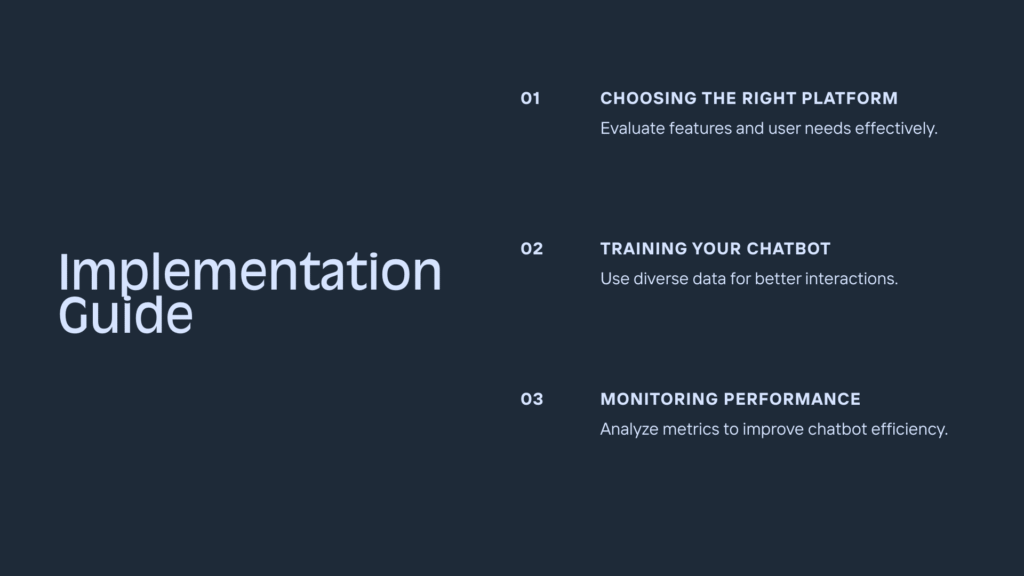
Implementing AI Chatbots for Support works best when businesses treat it as a structured support improvement project rather than a quick technology add-on. We usually begin by analyzing existing support conversations to understand where delays and repetition occur. From there we design chatbot flows around real customer behavior instead of theoretical scenarios. An AI customer support chatbot should feel like an extension of the support team, not a barrier between customers and help. This is why chatbot automation for customer service is introduced gradually. Starting with a few high-volume tasks makes the transition smooth for both customers and agents. Over time the chatbot takes on additional responsibilities as confidence grows. The benefits of AI chatbots in customer support appear much faster when implementation follows clear steps. Businesses avoid the common mistake of trying to automate everything at once. Instead they build a reliable system that grows with their support needs. That practical approach leads to long-term success.
Step 1: Define Your Customer Support Goals
Before implementing AI Chatbots for Support, we always ask businesses a simple question: what problem are we actually trying to solve? Sometimes the issue is slow response time. Other times it’s an overwhelming number of repetitive tickets. Defining this clearly helps shape how the AI customer support chatbot will be designed. Without clear goals, chatbot projects often become complicated and ineffective. Good chatbot automation for customer service focuses on measurable improvements such as reducing ticket volume or improving first response time. When the objective is clear, the automation flows become easier to design. Businesses also gain a clearer way to measure the benefits of AI chatbots in customer support once the system goes live. This step prevents unrealistic expectations and keeps the project focused. Instead of trying to build a “perfect” bot, the goal becomes building a useful one. That mindset usually leads to better long-term results.
Identifying Support Pain Points and Automation Opportunities
The best insights for AI Chatbots for Support usually come from existing support data. We review past conversations, ticket categories, and response times to identify patterns. Often the same ten questions generate a large percentage of the workload. Those questions become prime candidates for automation. An AI customer support chatbot can easily handle predictable scenarios like shipping inquiries or account access issues. This targeted chatbot automation for customer service removes pressure from the support team almost immediately. It also ensures the chatbot starts with tasks it can handle confidently. The benefits of AI chatbots in customer support become visible when repetitive tickets stop appearing. Businesses then gain clarity about which additional tasks could be automated next. Instead of guessing, the system evolves based on real data. That practical approach keeps automation useful rather than overwhelming.
Step 2: Choose the Right AI Customer Support Chatbot Platform
Selecting the right platform plays a big role in successful AI Chatbots for Support implementation. Some tools focus only on basic chat responses, while others integrate deeply with support systems and CRM tools. We usually recommend platforms that allow flexible chatbot automation for customer service without requiring complex development work. A good AI customer support chatbot should connect easily with websites, help desks, and internal databases. This allows it to provide real answers instead of generic replies. Businesses also need clear analytics to measure the benefits of AI chatbots in customer support over time. Without that visibility, it becomes difficult to improve the system. The platform should also allow easy updates as support needs change. When those elements are in place, the chatbot becomes a reliable operational tool rather than a temporary experiment.
Why Businesses Choose Platforms Like Yoursitechat
Many businesses choose platforms such as https://www.yoursitechat.com/ because they simplify the process of launching AI Chatbots for Support. Instead of building systems from scratch, companies can configure chatbot workflows using existing support knowledge. An AI customer support chatbot created through a platform like this can quickly connect to help documents, FAQs, and support databases. That makes chatbot automation for customer service much easier to deploy and maintain. Businesses also gain dashboards that track chatbot performance and user interactions. This helps teams understand the real benefits of AI chatbots in customer support rather than guessing about results. Another advantage is the ability to update responses without technical expertise. Support teams themselves can refine answers as new issues appear. Over time the chatbot becomes smarter because it evolves alongside customer needs. That adaptability is often the reason companies stick with platforms designed specifically for support automation.
Step 3: Train the Chatbot with Real Customer Data
Training is one of the most important steps when implementing AI Chatbots for Support. Without real examples, even the best AI customer support chatbot struggles to respond accurately. We usually begin by feeding the system past support conversations, help articles, and FAQ documentation. This gives the chatbot a realistic understanding of customer language. From there we refine responses based on how people actually ask questions. Effective chatbot automation for customer service depends heavily on this training phase. The more relevant data the system receives, the more helpful it becomes. Businesses often notice the benefits of AI chatbots in customer support improving steadily as the chatbot learns from real interactions. Early feedback also helps identify gaps in the knowledge base. Over time the system evolves into a reliable first layer of support rather than a simple scripted tool.
Building an Effective Knowledge Base
A strong knowledge base sits at the heart of successful AI Chatbots for Support. If the information behind the chatbot is unclear or incomplete, the responses will be too. We help businesses organize help articles, policies, and troubleshooting steps into structured content that the AI customer support chatbot can easily access. This improves both chatbot accuracy and overall support documentation. Good chatbot automation for customer service works best when answers are simple, direct, and easy to update. As the knowledge base grows, the chatbot becomes more capable of resolving issues without human intervention. The benefits of AI chatbots in customer support increase because the system handles a wider range of questions confidently. Businesses also gain a cleaner internal resource for their human agents. In many cases, improving the knowledge base benefits the entire support operation. The chatbot simply becomes the fastest way for customers to access that information.
Step 4: Integrate the Chatbot with Your Website and CRM
Integration is where AI Chatbots for Support become truly useful. When connected to the right systems, an AI customer support chatbot can access order details, account information, and previous conversations instantly. This makes chatbot automation for customer service far more effective than simple FAQ responses. Customers can check order status, update information, or retrieve account details without leaving the chat window. Support agents also receive better context when a conversation gets escalated. The benefits of AI chatbots in customer support expand significantly once the chatbot interacts with real data. Instead of providing general guidance, it becomes an operational tool. Businesses often notice that customers begin solving problems directly through chat. That shift reduces both email tickets and phone calls. Over time the support workflow becomes faster and more organized.
Using Solutions Like https://www.yoursitechat.com/ for Easy Integration
Platforms like https://www.yoursitechat.com/ make it easier to deploy AI Chatbots for Support without complex technical work. Businesses can connect their AI customer support chatbot to websites, CRM systems, and help desks through simple integrations. This makes chatbot automation for customer service practical even for smaller teams without dedicated developers. Once connected, the chatbot can pull real customer data to provide accurate responses. For example, it can display order updates or create support tickets automatically. The benefits of AI chatbots in customer support increase dramatically when the chatbot interacts with these systems. Instead of acting like a standalone tool, it becomes part of the existing support infrastructure. Businesses also gain better reporting because chatbot interactions are logged alongside other support activities. That unified view helps teams improve both automation and human support processes.
Step 5: Monitor Performance and Improve Chatbot Responses
Launching AI Chatbots for Support is only the beginning. The real improvement happens when businesses monitor conversations and refine responses over time. An AI customer support chatbot should be reviewed regularly to identify where it succeeds and where customers still need human help. These insights help expand chatbot automation for customer service into new areas gradually. For example, a common unresolved question might become the next automated workflow. Businesses also track key metrics to understand the benefits of AI chatbots in customer support clearly. That might include ticket reduction, faster response times, or improved customer satisfaction scores. Continuous improvement ensures the chatbot remains helpful rather than outdated. Support teams also become more comfortable relying on automation as accuracy improves. Over time the system evolves into a dependable part of daily operations.
Tracking ROI and Customer Satisfaction Metrics
Measuring results is essential when evaluating AI Chatbots for Support. Businesses typically track metrics such as ticket deflection rate, average response time, and chatbot resolution percentage. These numbers help determine whether the AI customer support chatbot is truly reducing support workload. Effective chatbot automation for customer service should gradually lower the number of repetitive tickets reaching human agents. At the same time, customer satisfaction scores should remain stable or improve. This combination reveals the real benefits of AI chatbots in customer support. Businesses also gain insights into which questions appear most frequently. That data often leads to improvements in product documentation or website design. Over time the chatbot becomes both a support assistant and a valuable analytics tool. Instead of guessing about support challenges, companies make decisions based on actual customer interactions.